
Understood and Forwarded
The Challenge
Spam and non-actionable emails have long plagued operational teams: consuming mailbox storage, cluttering queues that require urgent attention, and eating away valuable hours. While deleting an individual email takes only seconds, the cumulative volume compounds over time, adding up to entire workweeks lost every year.
Furthermore, standard rule-based filters fall short in nuanced scenarios: thank-you notes, polite confirmations, or messages requiring no further action that still include internal corporate domains in recipient fields.
The Context
Email represents the primary communication lifeline at B3 across customer support operations, internal procedures, and official milestone sign-offs. Customer service operations rely heavily on swift, accurate triage to assign correct priority according to strict SLAs and issue complexity.
Mailbox rules help, but they are not a silver bullet. Certain incoming messages must be read and understood in their entirety before categorization—otherwise, a company risks misclassifying a critical ongoing case, directly harming operational NPS.
The Idea
The core capability of modern language models (LLMs and SLMs) is their sophisticated comprehension of unstructured text. Why not leverage this power to read and categorize incoming emails, saving valuable operator time while continuing to triage requests around the clock?

Applying rigorous data anonymization protocols, the AI model needed only to determine whether an email required concrete action or represented an already-resolved topic. Going further: the system could integrate directly into B3's internal ticketing infrastructure, triggering the exact automated workflows operators previously ran by hand.
The Real Barriers
Uncompromising compliance with data privacy regulations (LGPD) was absolute and non-negotiable. Protecting sensitive financial and personal data required strict anonymization pipelines before interacting with machine learning inference models.
Customer service teams handle an extensive breadth of financial transactions, making it impractical to classify messages into hundreds of hyperspecific buckets. We had to analyze operational distributions and identify high-frequency priority categories.
Moreover, modern AI models are not infallible. An erroneous classification could leave an urgent client matter unattended, with consequences identical to an operational outage.
Finally, to deliver measurable efficiency, the agent had to perform operational tasks: registering tickets, looking up existing protocols, and escalating to human analysts whenever classification confidence fell below safety thresholds.
Safeguarding service quality remained our paramount principle.
The Solution: AI Email Triage
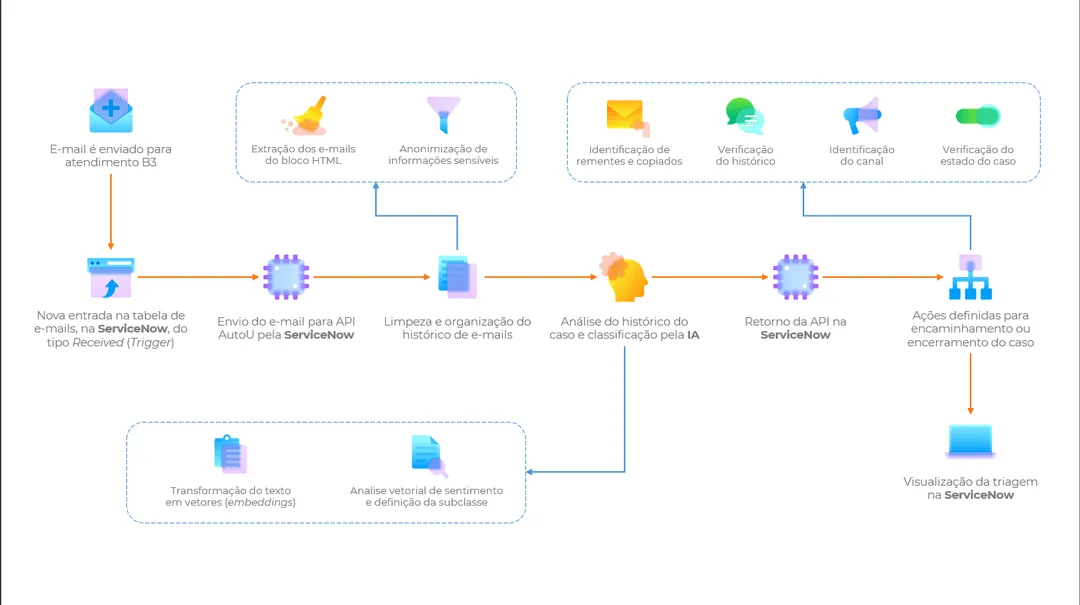
An automated classification engine designed to handle hundreds of daily emails and sort them into four clear categories: Actionable, Thank-You/Acknowledgment, Informational Copy, and Auto-Reply.
Classification in seconds: The language model parses unstructured text and classifies emails in under two seconds. This rapid throughput is essential for high-volume queues, ensuring zero latency bottlenecks in customer operations.
Workflow reusability: Support teams already had validated automated resolution procedures within ServiceNow for closing acknowledged tickets. The AI system connects directly to these existing APIs upon recognizing non-actionable thank-you notes.
Abstention philosophy: The classification engine was calibrated with strict confidence thresholds. If language ambiguity or contextual nuance creates doubt, the system deliberately abstains and routes the email to a human operator for final verification.
What Truly Changed

Focused, elegant automation eliminated bottlenecks by recovering precious minutes across every operator's daily routine.
Second-tier operational throughput accelerated noticeably. Inquiries advanced through their workflow stages on the very day of submission, drastically improving resolution velocity.
Key Learnings
Simplicity accelerates success. Attempting to exhaustively classify dozens of edge cases upfront would have introduced unacceptable project risk. Eliminating non-actionable correspondence was sufficient to recover hours of high-value operational capacity every day.
Do not reinvent the wheel. Integrating the solution into pre-existing ServiceNow workflows significantly shortened delivery timelines, allowing engineering efforts to focus on model accuracy and calibration. Building on proven internal tooling honors prior organizational investments.
Human-AI collaboration. This implementation stands as a premier example of AI augmenting rather than replacing human talent. Human operators remain central to resolving high-stakes requests, while the AI quietly handles low-complexity clerical volume.
Case AutoU + B3 — Intelligent Email Triage with AI