
How PRIO Transformed Legal Management into a Strategic Platform to Connect Teams, Accelerate Decisions, and Provide Operational Visibility
The Challenge
PRIO's legal department sits at the center of virtually every critical corporate milestone. Commercial contracts, court litigations, corporate reorganizations, formal legal opinions, approvals, and strategic documentation flow through the department every day. The obstacle was never the capability of the attorneys, but rather the way information was tracked and administered.
Every workflow followed an idiosyncratic path. Files were scattered across spreadsheets, email threads, and local folders. Tracking demand status frequently relied on the tacit knowledge of specific individuals. Requesting updates, retrieving files, or tracing the history of a negotiation required substantial time and constant cross-department inquiries.
As PRIO expanded aggressively, this manual model became unsustainable. The mandate was not simply organizing files, but creating a unified way to govern the entire legal lifecycle with security, traceability, and speed.
The Context
Legal work never unfolds in an isolated bubble. Each contract affects multiple business operations. A litigation case may involve multiple corporate entities and multidisciplinary teams. An M&A transaction brings together due diligence files, regulatory queries, and board decisions that must be accessible across key milestones, each with distinct accountability requirements.
Without a single operational perspective, monitoring workflow progress was slow, driving up reliance on direct inquiries to legal staff to retrieve data that already existed but was buried in email threads and shared network drives.
What was needed was not yet another generic legal software. It was a digital platform capable of unifying people, data, and workflows in one place.
The Idea
The goal was never merely converting paperwork into digital files.
The vision was building a comprehensive management platform tracing PRIO's entire legal lifecycle—from the initial intake of a demand to delivery tracking, document storage, digital signatures, assigned owners, and historical audit logs for every operation.
With all information centralized, structured, and synchronized in real time, the legal team could transition from reactive request-handling to proactive, predictable delivery. Concurrently, business units gained full self-service visibility into matters affecting their day-to-day operations.
Technology was the enabler to make this seamless cross-functional collaboration a reality.
The Real Barriers
The project's complexity went far beyond developing an application. It required accurately mapping intricate legal workflows that differ based on demand category, requesting department, and operational criticality.
Contracts, civil/labor litigations, and corporate M&A transactions follow completely different lifecycles, require distinct documentation, and serve separate requirements. The solution had to support this diversity effortlessly without complicating the daily user experience.
Another core challenge was ensuring multiple teams collaborated over the identical record, while upholding granular role-based access permissions, version tracking, and complete audit trails for every action.
It was equally vital to minimize manual clerical work for attorneys without sacrificing rigorous governance over approvals, draft reviews, document histories, and sign-offs.
The Solution: PRIO Legal
PRIO Legal was established as the enterprise hub for corporate legal operations.
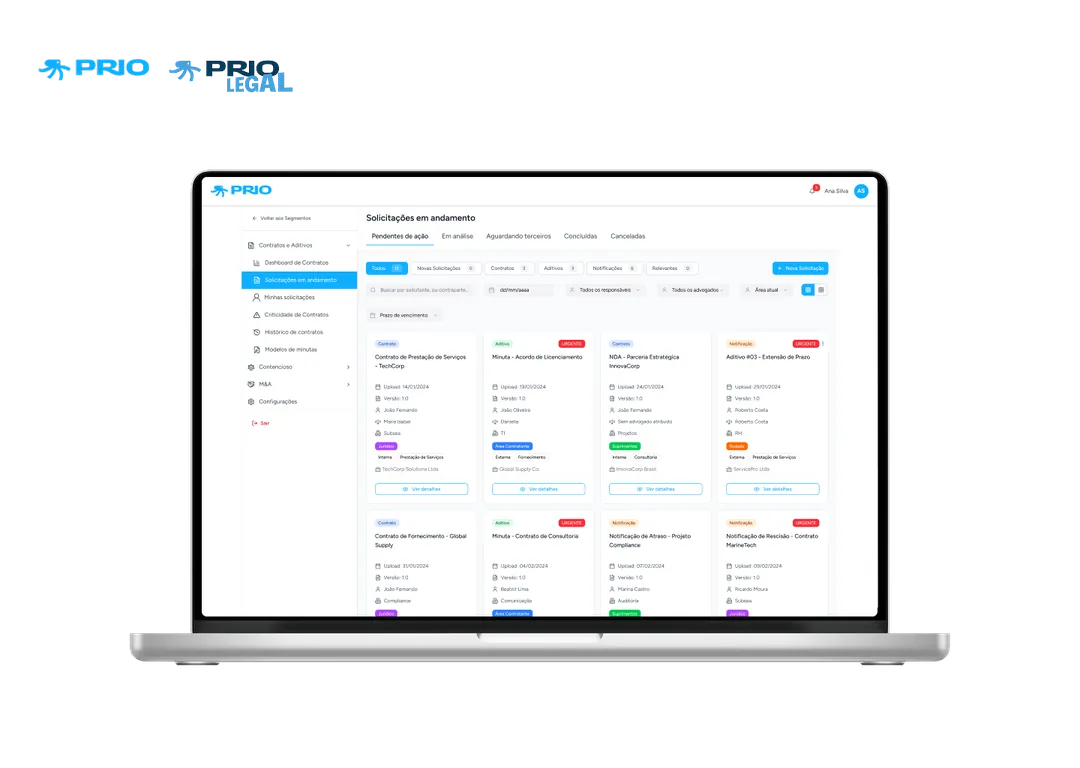
All legal demands are now logged, tracked, and organized within a centralized portal, enabling contracts, lawsuits, strategic files, and corporate filings to be governed integrally.
Every case file maintains a complete chronological ledger, clear ownership, due dates, linked exhibits, and up-to-date milestone statuses.
Standardized workflows automate tasks that previously depended on manual spreadsheets, while automated real-time notifications eliminate the need for routine status-check emails to the legal department.
The platform also incorporates native AI capabilities to assist with high-friction tasks that once dominated attorneys' time—accelerating data organization,
document information extraction, and contract draft generation, while always ensuring a legal specialist retains final editorial review and approval.
The result is a connected, transparent operation built to keep pace with rapid enterprise expansion.
Technical Architecture
The platform was engineered as an enterprise web portal architected to handle diverse user roles, granular permissions, and concurrent operational workflows.
Its architecture consolidates legal information into a single relational schema, allowing contracts, lawsuits, documents, and corporate demands to share operational context and audit history without data duplication.
The platform seamlessly integrates automated workflows, robust access controls, document versioning, and applied artificial intelligence models that accelerate data extraction and knowledge discovery, substantially reducing manual workload.
Furthermore, every operation was built to guarantee comprehensive audit traceability, providing enterprise-grade governance and reliability for a department handling critical corporate assets.
User Experience (UX)
UX design prioritized clarity within an inherently intricate regulatory environment.
Navigation is organized so each user profile sees only the metrics and tasks relevant to their immediate responsibilities, eliminating visual noise and streamlining workflow oversight.
Instant access to contract intakes, litigation cases, intelligent filtering, historical timelines, and visual status badges allows users to find critical records in a few clicks, while automated notifications ensure cross-departmental alignment during execution.
Rather than forcing teams to adopt an unnatural process, the platform was modeled around the real-world operational rhythms of corporate legal teams.
What Truly Changed
Impact materialized rapidly because transformation occurred not merely in software, but in how company departments collaborate.
Within just six months of rollout, the platform was already managing more than 800 legal cases logged and actively monitored in a single portal.
Average legal response turnaround dropped to under a day, reaching an impressive 0.8 days, drastically speeding up decision-making across teams.
More than 15 distinct PRIO departments now monitor real-time legal updates directly, removing dependencies, elevating transparency, and fostering cross-functional alignment.
Far beyond organizing documents, PRIO Legal transformed legal operations into a trusted strategic knowledge asset powering high-level business decisions.
Key Learnings
Digitizing corporate legal is not about uploading PDFs into folders. It is about making specialized operational intelligence securely accessible to decision-makers precisely when needed.
Another core takeaway was that legal platforms unlock exponential value when they bridge gaps between corporate divisions. Legal remains the guardian of compliance, but ceases to be an informational bottleneck.
It was equally evident that artificial intelligence delivers peak utility when augmenting human expertise rather than trying to displace it. By removing clerical toil and organizing complex records, technology frees attorneys to focus on their core differentiator: strategic analysis, negotiation, and judgment.
Ultimately, the project's greatest asset was not merely software: it was a robust operating model linking people, processes, and intelligence to support PRIO's aggressive growth with speed, governance, and trust.
Case AutoU + PRIO3 — PRIO Legal: Legal Platform