
How Grupo JGV Transformed Inventory Management with Predictive Analytics and Over 118,000 Products Processed Daily
An intelligent recommendation system that anticipates demand, reduces manual analysis, and supports purchasing and branch transfer decisions
Grupo JGV needed to make spare parts management more predictable, efficient, and data-driven. To accomplish this, AutoU engineered an integrated platform connected to Sankhya ERP capable of analyzing branch inventories, forecasting demand over a rolling 30-day horizon, and generating automated replenishment recommendations for manager validation.
1. The Challenge
Grupo JGV faced an obstacle that appeared operational on the surface, but involved an intricate blend of transactional data, demand forecasting, and distributed decision-making across branch locations.
Analyzing spare parts procurement and sales historically depended on records found across fiscal invoices, sales orders, and ERP tables. Although the enterprise possessed vast data volumes, translating raw logs into actionable purchase orders required extensive manual calculations.
This operational dynamic produced four critical bottlenecks:
- Massive data volume: Thousands of records had to be cross-referenced across sales histories, current stock levels, open purchase orders, and inter-branch transfers.
- Risk of stockouts or overstocking: Without unified operational visibility, one branch might over-procure while another suffered severe inventory shortages.
- Neglect of demand seasonality: Rudimentary historical reviews failed to capture recurring cyclical variations in parts consumption.
- Reactive decision-making: Orders were driven primarily by lagging movement logs rather than forward-looking predictive models.
The resulting process was time-consuming, vulnerable to distortion, and heavily reliant on individual managers manually crunching spreadsheets.
2. User and Operational Context
The system had to support an enterprise ecosystem where distinct stakeholders share responsibility for inventory replenishment.
The procurement manager is responsible for reviewing branch requisitions, tuning quantities, and issuing purchase orders. Meanwhile, the sales manager participates in validating inter-branch transfers, verifying that outbound stock can be relocated without compromising local operational service levels.
These managers possessed deep domain expertise. The constraint was never lack of skill, but rather the sheer volume of SKUs requiring daily evaluation before reaching a decision.
Furthermore, substitute products, open vendor orders, internal transfers, and regional branch differences added layers of complexity. A naive recommendation looking only at current stock on hand might trigger an unnecessary purchase, overlook an incoming shipment, or fail to reallocate surplus inventory from a nearby sister branch.
Consequently, the solution could not simply automate order creation blindly. It had to structure data, produce transparent, explainable recommendations, and keep managers firmly in control of purchasing decisions.
3. The Idea
The core philosophy was transforming Grupo JGV's transactional history into a continuous decision-support engine.
Since the ERP already tracked sales, warehouse balances, item catalogs, branches, and purchase orders, this telemetry could be modeled to forecast future demand and pre-empt shortage or overstock conditions.
The strategy was structured in three phases:
1. Forecast future product demand for every SKU at each branch.
2. Compare forecasts against available on-hand stock and inbound purchase orders.
3. Recommend the optimal operational action before supply issues materialize.
Rather than defaulting to external vendor purchases, the engine first evaluates whether another branch within the corporate group holds surplus inventory. When viable, an inter-branch transfer is prioritized over a new external purchase order.
The underlying hypothesis was clear: by merging time-series forecasting, business logic rules, and human-in-the-loop review, the organization could eliminate manual toil while retaining commercial judgment over high-value orders.
4. Barriers and Complexities
The concept sounded straightforward: analyze stock and recommend what to buy. In production, delivering trustworthy recommendations required solving intricate technical and operational challenges.
Differentiating real demand from internal movements
Not every ledger movement in the ERP represents authentic market consumption.
Internal transfers, routine replenishments, and specific purchasing entries were initially being ingested by the forecasting model as customer demand, skewing historical baselines. We overhauled the ingestion filters so that only transactions representing genuine external consumption fed the forecasting pipeline.
Retained in calculation:
- Customer sales orders;
- Service requisitions with confirmed reservations.
Excluded from calculation:
- Inter-branch warehouse transfers;
- Internal administrative purchase receipts;
- Journal adjustments not tied to real customer consumption.
Factoring in open purchase orders
A projected shortfall could generate a redundant replenishment recommendation even when an open purchase order was already awaiting delivery from suppliers.
The integration was enhanced to ingest pending purchase orders, preventing duplicate procurement and grounding calculations in true net projected availability.
Evaluating multi-branch transfers
It was not enough to detect that another branch held the item in stock. The transfer recommendation had to satisfy strict operational rules, including:
- Source and destination branches belonging to the same legal business unit;
- Configured minimum transfer order quantities;
- Preserving mandatory safety stock buffers at the donor branch;
- Adequate post-transfer availability to support local demand.
Managing similar and substitute parts
In many instances, an out-of-stock item could be seamlessly substituted by an officially certified alternative already sitting on warehouse shelves.
The engine was integrated with Sankhya's substitute parts catalog, evaluating current stock, unit cost, operational eligibility, and commercial restrictions before proposing an approved substitute.
Maintaining governance and explainability
Despite algorithmic automation, replenishment orders could not be dispatched fully autonomously. A mathematically sound recommendation might overlook promotional marketing campaigns, bulk supplier negotiations, or regional market realities.
Therefore, all system suggestions remain subject to human review and approval before purchase orders are committed to the ERP.
5. The Solution
AutoU engineered an inventory optimization platform deeply integrated with Sankhya ERP, combining time-series forecasting, deterministic business rules, and an intuitive decision portal for branch managers.
Every night, the platform ingests synchronized operational records and analyzes every SKU-branch combination. The model forecasts demand across the next 30 days and contrasts projected consumption against physical stock, open supplier shipments, safety thresholds, and company policy.
When stockout risks are identified, the system applies a hierarchical decision tree:
1. Check for surplus stock at a sister branch within the corporate group;
2. If surplus exists, generate an inter-branch transfer recommendation;
3. If unavailable, evaluate approved substitute or compatible SKUs;
4. If no internal alternative exists, generate an external purchase recommendation.
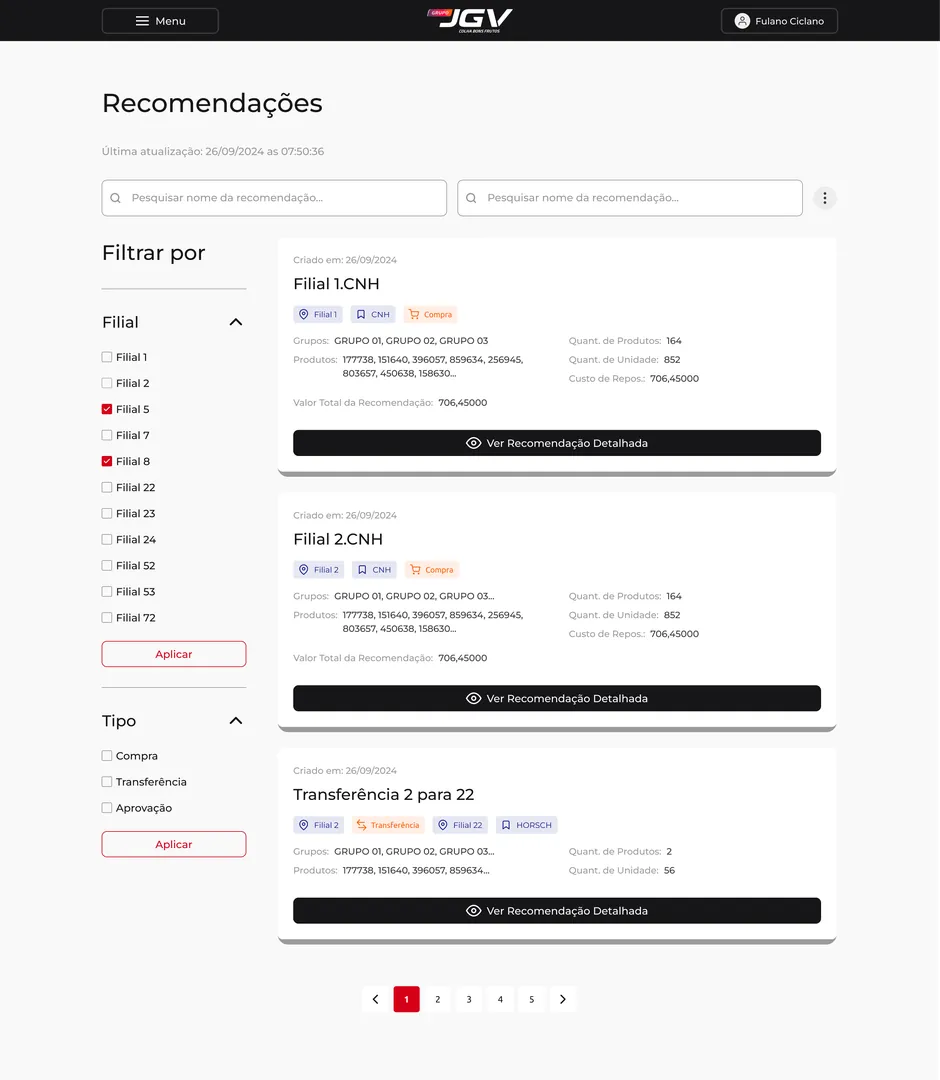
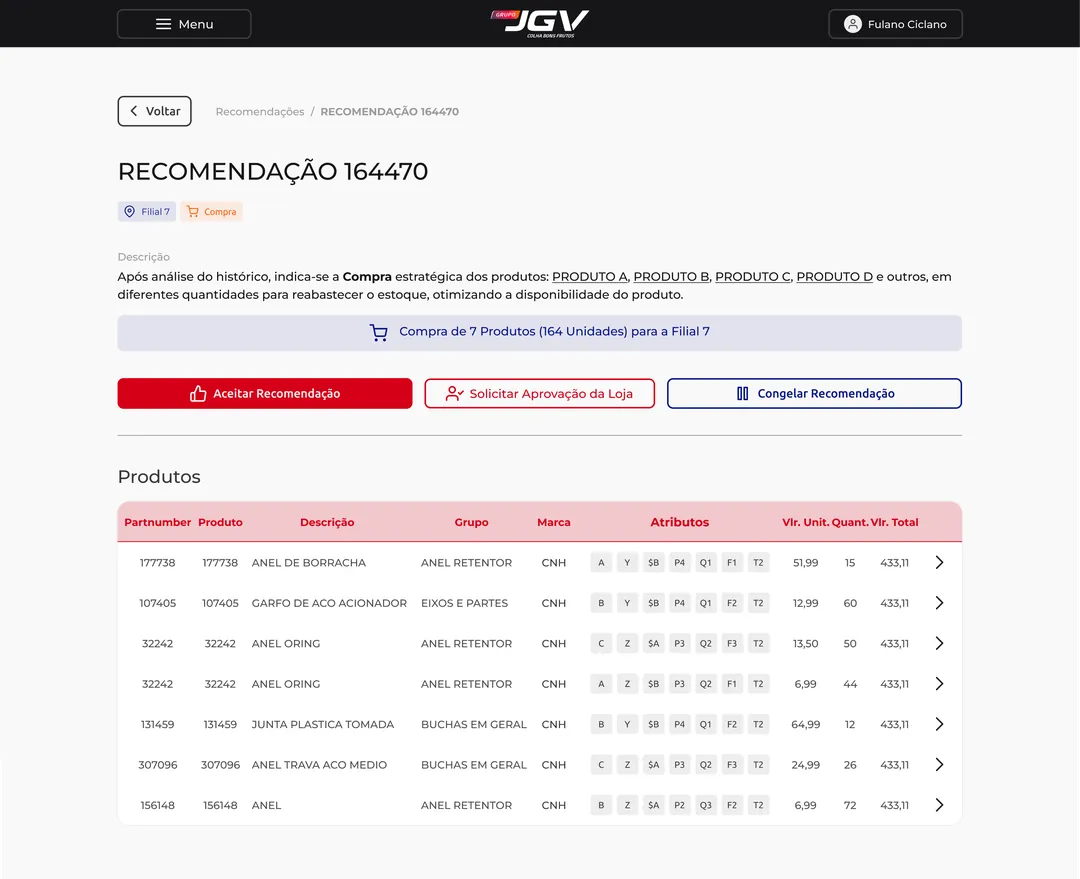
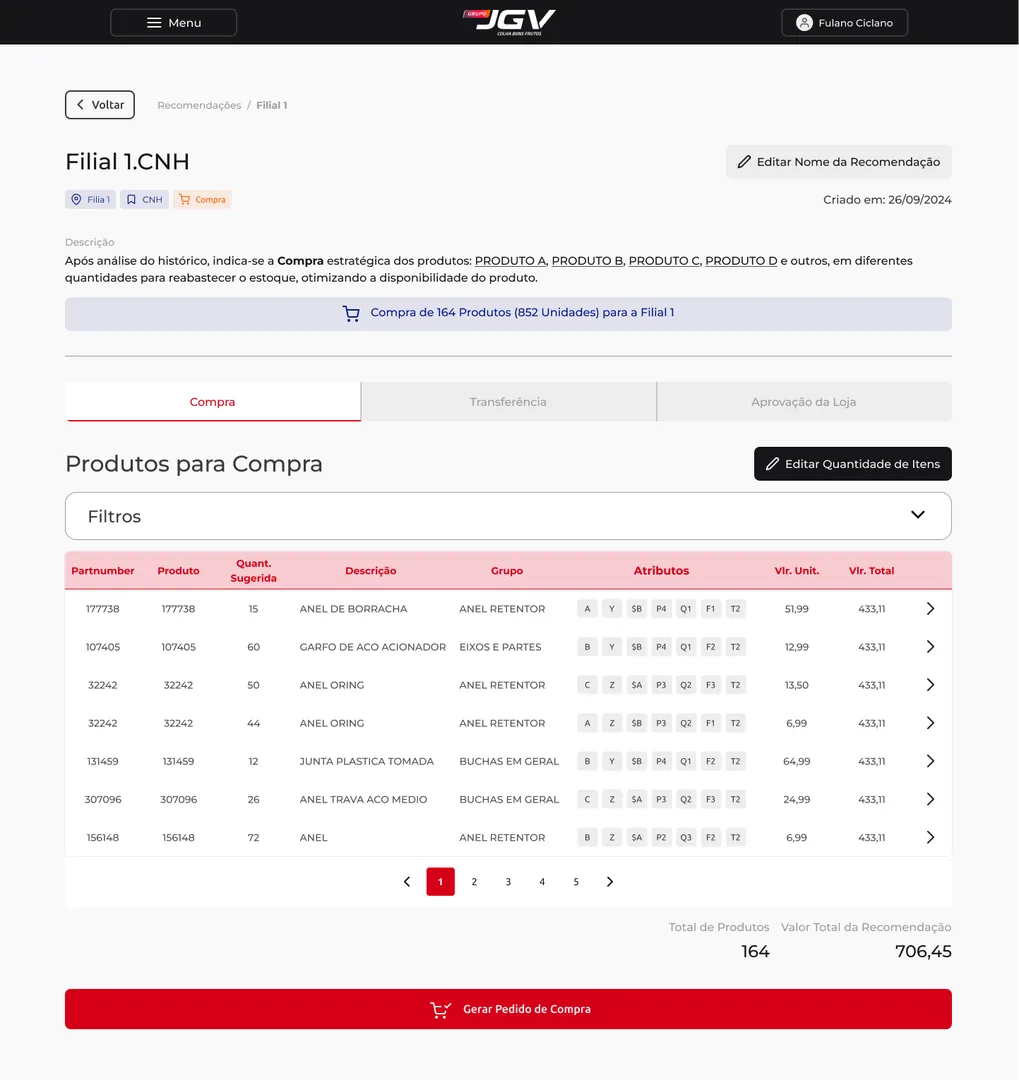
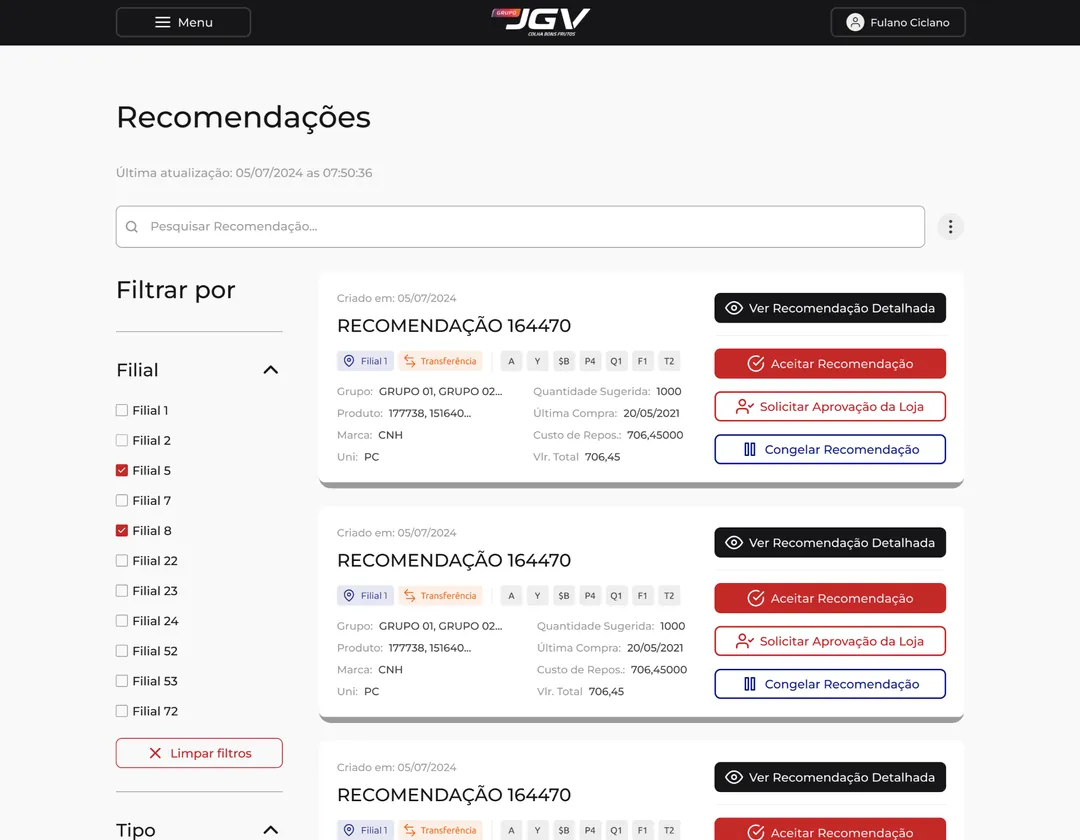
Recommendations are surfaced on the web portal where managers can approve, reject, zero out, or fine-tune suggested quantities.
Only verified and approved items are committed to Sankhya, where they enter the company's existing enterprise purchase approval workflow.
6. Technical Architecture
The system executes through scheduled nocturnal batch processing routines.
1. Data extraction
The pipeline queries Sankhya via secure REST APIs and optimized SQL views, extracting:
- Historical sales orders;
- Live warehouse balances by branch;
- Active product catalogs and master data;
- Legal entity and branch groupings;
- Pending purchase orders;
- Inventory ledger transactions;
- Substitute and compatible item tables;
- Commercial classifications and attributes.
2. Time-series historical preparation
Movement records undergo rigorous data cleansing to filter out internal ledger reallocations that do not reflect external customer demand.
Cleaned sales datasets ensure pure consumption series feed predictive modeling.
3. Demand forecasting
For each active SKU and branch pair, Facebook Prophet models analyze historical multi-year time-series trends, incorporating:
- Underlying linear and non-linear trends;
- Recurring weekly and monthly seasonality;
- Cyclical spikes and holiday variations;
- Demand growth or shrinkage velocity.
The model outputs a rolling 30-day demand forecast used as the baseline for replenishment calculations.
4. Business rule execution
Forecasted demand feeds into a deterministic recommendation engine.
The engine factors in:
- Current available stock;
- Forecasted consumption;
- In-flight purchase orders;
- Supplier lead times;
- Target safety stock buffers;
- Minimum batch transfer sizes;
- Group branch surplus availability;
- Inactive or frozen SKUs;
- Substitute item inventory;
- Brand analysis filters.
5. Persistence and presentation
Generated recommendations are persisted to PostgreSQL with pending review status and presented within the web application.
Audit logging tracks the rationale, algorithmic parameters, and manager overrides for every recommendation.
6. Outbound ERP integration
Following manager review:
- Approved purchase recommendations dispatch purchase orders into Sankhya;
- Approved transfer recommendations initiate logistics routing;
- Integration exceptions are flagged on the dashboard to prevent lost recommendations.
7. User Experience
The UI was engineered to streamline reviewing hundreds of high-value recommendations in minutes.
Rather than manually navigating multiple ERP screens, managers view a consolidated workbench prioritizing items requiring immediate action.
For every recommendation, the manager can:
- Approve suggested quantity with a single click;
- Modify the replenishment quantity;
- Reject the suggestion;
- Zero out the line item;
- Inspect underlying forecast curves and historical consumption;
- View source and destination transfer branch details;
- Review viable substitute products;
- Trace past replenishment decisions.
Inline editing allows instant adjustments directly on the data grid, backed by instant inventory validation checks.
Quick actions enable bulk rejection or zeroing without opening individual modal dialogs, significantly accelerating purchase order review.
The operational dashboard complements daily execution by tracking:
- Branch inventory balances;
- Forecast accuracy trends;
- Historic recommendation acceptance rates;
- Dead stock and excess inventories;
- Frozen or obsolete SKUs;
- Purchase orders generated by date.
The UX philosophy transformed complex statistical modeling into an actionable, transparent operational workflow without concealing the analytical rationale behind each suggestion.
8. Key Evolutions Delivered
The platform advanced across 6 agile development sprints, delivering algorithmic refinements and portal capabilities.
Key highlights include:
Inclusion of open purchase orders
In-transit and unfulfilled supplier purchase orders were factored into net available stock, eradicating redundant duplicate procurement.
Predictive calculation audit
Prophet historical datasets were cleansed to exclude non-consumption internal movements.
Conditional inter-branch transfers
Prioritizing intra-group branch reallocations before routing orders to external suppliers.
Automated substitute part routing
Consulting Sankhya substitute cross-references to propose in-stock equivalent parts.
Substitute recommendations satisfy:
- Physical on-hand stock greater than zero;
- Validated cost registry at destination branch;
- Operational compatibility;
- Active SKU status.
Direct ERP attribute synchronization
Real-time ingestion of commercial classifications directly from Sankhya master tables.
Brand filtering
Allowing managers to scope recommendation generation to selected manufacturer brands.
Direct grid quantity editing
Enabling rapid quantity adjustments with live constraint checking.
One-click zero and reject actions
Minimizing interaction overhead during high-volume replenishment review sessions.
Dynamic planning horizon calculation
Allowing managers to recalculate suggested quantities across variable forecast horizons.
Auditable recommendation history
Time-indexed recommendation ledgers providing complete compliance and managerial auditability.
Internal infrastructure migration
Migrating workloads to internal enterprise infrastructure for enhanced security and data governance.
9. Results
The platform modernized a fragmented, manual inventory review into an automated, predictable, and forecast-driven operation.
Reported production outcomes:
- Over 118,000 products automatically evaluated every day;
- Approximately 80% manager approval rate for generated recommendations;
- Sub-5-second processing latency per product evaluation;
- Around 9,700 hours saved annually in manual analytical tasks.
Beyond massive time savings, the solution actively pre-empts stockouts, curbs surplus accumulation, and maximizes existing branch inventories before cash is deployed on supplier purchases.
The architecture established a rigorous governance layer: every suggestion carries timestamped inputs, applied heuristics, status transitions, and final manager decisions.
10. Learnings
A primary learning was that forecasting precision depends far less on mathematical model complexity than on accurately defining true customer demand.
Originally, internal movements inflated historical sales curves. By filtering the dataset down to verified sales and service reservations, model forecasts converged tightly with actual customer purchasing behavior.
Another lesson was that predicting a stockout is only half the battle. A truly actionable recommendation must absorb the full operational environment.
In this engagement, that required integrating:
- In-flight purchase orders;
- Sister branch surplus stock;
- Corporate entity hierarchies;
- Safety stock thresholds;
- Equivalent and substitute SKUs;
- Inactive or discontinued items;
- Cost constraints and freight minimums.
The solution confirmed that automation and human oversight are complementary forces. Machine learning eliminated the cognitive overload of sorting thousands of SKUs, while human approval preserved commercial intuition and unmodeled market nuances.
Lastly, the project identified an exciting frontier for future development: balancing logistics freight costs against supplier procurement costs when evaluating transfers versus purchases.
The platform stands as proof that integrating predictive AI with enterprise ERP systems turns scattered data into swift, auditable, and proactive decisions.