
From 30 to 7 Days: How ISA Energia Automated Electrical Engineering Project Reviews with AI
The Problem
Engineers at ISA spent entire workdays manually reviewing technical documentation—not for lack of engineering initiatives, but because high-value engineering was buried beneath manual clerical triage.
Even a modest electrical transmission project arrives as a package containing up to 1,200 technical files: PDFs, TIFFs, DWGs. Each diagram must be thoroughly parsed, verified, and cross-referenced against regulatory standards prior to sign-off. As project portfolios expanded, analysts struggled to reach the critical technical analyses that truly mattered. The bottleneck was not competence—it was time.
Hiring additional personnel failed to solve the issue: legacy schematics were scanned blueprints with inconsistent stamping layouts spanning decades and regional styles. Any solution relying purely on manual human effort multiplied operational costs far faster than output.
The Idea
The insight was simple: if mechanical clerical labor consists of reading, extracting, and cross-checking data, AI should absorb that layer. The certified engineer remains responsible for the technical decision; they simply stop wasting days getting to it. It was a classic operational challenge that finally had mature, reliable technology to resolve it permanently.
The Real Barriers
Execution proved far more intricate than the initial concept indicated. Three concrete operational hurdles had to be solved:
Data standardization: Blueprints spanning multiple eras and contractors arrived with scanning noise, skewed margins, and disparate title block layouts. Training computer vision models solely on pristine, modern CAD samples led to failure in production, so training datasets had to reflect the true historical messiness of the archives.
Scale and throughput: Processing 1,200 heavy blueprints in sequential queues produced unacceptable turnaround delays. We restructured the backend for parallel distributed processing, cutting latency by 60% and enabling smooth continuous throughput.
Domain-specific technical rigor: Flagging discrepancies across electrical schematics demands far more than off-the-shelf OCR. Cross-validation rules between circuit diagrams and technical specifications require deep electrical domain logic, requiring our engineers to fully immerse themselves in substation operations.
The Solution: ISACAD
The platform was engineered across three dedicated modules, each targeting a specific layer of the verification pipeline.
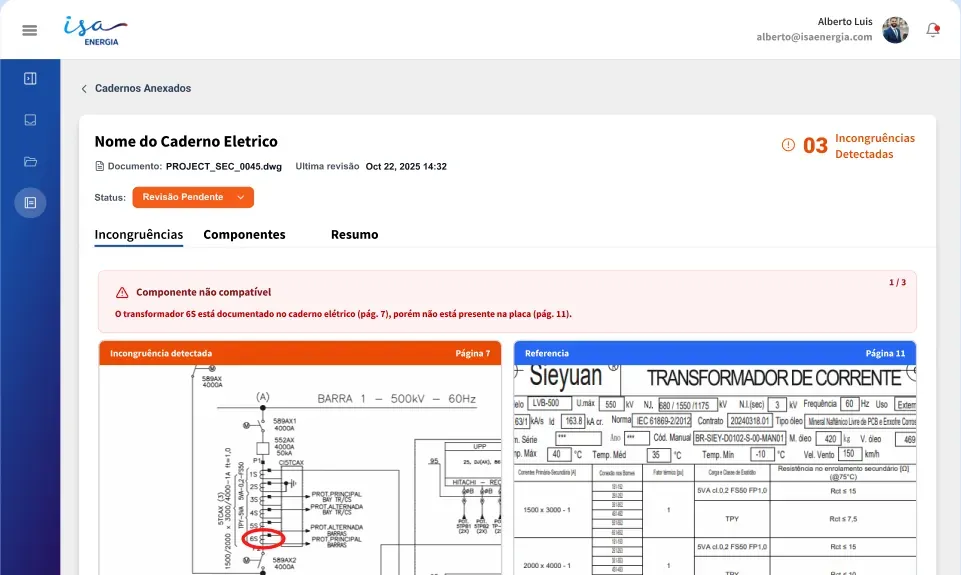
Module 1 - Title Block and Stamp Extraction: Users upload document packages and the platform takes over. Every engineering drawing contains a title block with critical metadata previously transcribed by hand. The system automatically detects, crops, and extracts this information, consolidating everything into a structured, standardized comparative dashboard in real time.
Module 2 - Electrical Schematic Analysis: With drawings indexed, the second stage begins: in-depth technical analysis of the electrical schematics. Computer vision identifies critical components, cross-references wiring specs across files, and flags discrepancies with direct visual bounding boxes. Pre-analysis that once took days is ready before the engineer opens the first file. The model retrains weekly based on engineer feedback: the more it is used, the more accurate it becomes.
Module 3 - Wattson: ISA's conversational AI assistant, fine-tuned on the vocabulary of electrical transmission engineers and technical standards. An engineer enters a natural-language query: "What metering points are available on this circuit?", receiving a verified answer in under 5 seconds by querying the digital points database and ISA business rules—without opening spreadsheets or hunting down senior personnel.
Platform Workflow
Results
Across packages of 1,200 documents:
30 days → 7 days project review delivery time (~75% reduction)
98% accuracy in metadata extraction and component detection
60% reduction in queue wait time via parallel processing architecture
< 5 seconds average response time for Wattson inquiries
Weekly continuous retraining—system intelligence that compounds with use
The most meaningful outcome was not captured on standard KPI dashboards: engineers returned to practicing true engineering. Time once lost to clerical triage is now dedicated to high-level system analysis that genuinely requires expert human judgment.
Key Learnings
Clean datasets are a trap. Models trained only on crisp, modern digital drawings might look impressive in staging tests, but crash in production. Real-world industrial success demands training on diverse, noisy legacy archives.
Parallelism is a fundamental requirement. In high-volume industrial processing, sequential queues inevitably create bottlenecks. Parallel execution was essential for production performance.
Accessible technical knowledge dismantles operational silos. Wattson was initially underestimated, but democratizing instant access to technical standards solved an unspoken operational pain point: over-reliance on individual veteran specialists for routine inquiries.
Case AutoU × ISA — Intelligent Electrical Engineering Review Platform (ISACAD)