
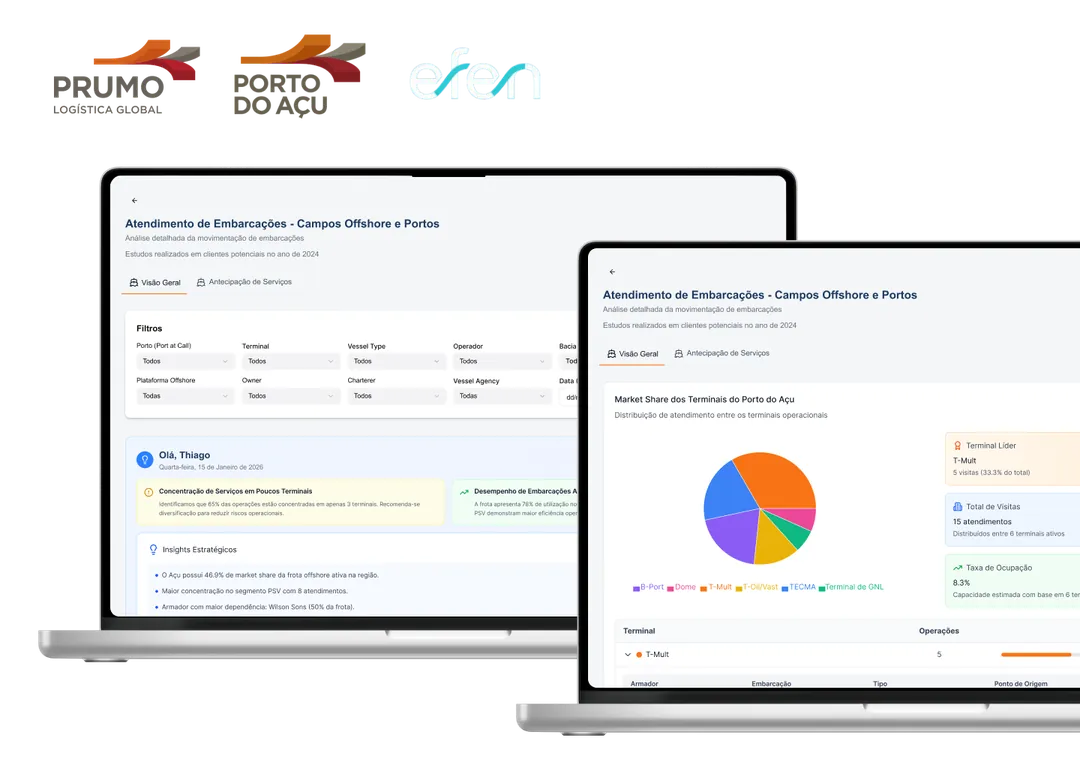
How PRUMO Transformed Dispersed Data into Market Intelligence to Create New Revenue Streams at Port of Açu
The Challenge
Every single day, thousands of data points are generated by operations at Port of Açu and across its business ecosystem.
Port movements, vessel bunkering, dockings, offshore positioning, and maritime market indicators were recorded in disparate systems, each serving only its immediate operational silo.
Individually, these datasets held inherent value. The bottleneck was that they remained completely isolated.
Without a unified perspective, answering strategic business inquiries required laborious manual compilation, complex spreadsheet cross-referencing, and massive effort to translate raw data into actionable decisions.
PRUMO envisioned a different path: what if these datasets, when shared and analyzed collectively, could uncover business opportunities that no single company could detect in isolation?
Beyond building software, the true challenge was proving that shared data could unlock fresh revenue streams across the entire port ecosystem.
The Context
Port of Açu hosts a multitude of independent enterprises operating daily across the same shared maritime and logistics infrastructure.
Port operator PRUMO manages core infrastructure. EFEN executes marine refueling operations. Additional companies deliver complementary services, while external global intelligence regarding vessel movements and market dynamics flows in continuously.
Each organization possessed only a piece of the puzzle.
What was missing was connecting these varied viewpoints to understand holistic maritime market trends.
Answering questions such as which shipowners are docking at competing ports, which services are not yet offered at Açu, or which vessels will require refueling in the coming weeks hinged directly upon this unified vantage point.
It represented a prime opportunity to transform operational logs into commercial intelligence.
The Idea
The objective was never simply to assemble another dashboard.
The core concept was engineering a platform that converts raw data into an appreciating strategic asset.
To achieve this, we needed an environment where data originating from varied companies, operational software, and external feeds could be ingested, normalized, linked, and analyzed in unison.
Instead of each player examining only their internal records, Datadock would enable market pattern recognition, anticipate commercial leads, and empower data-driven decisions across the whole port.
Simultaneously, the project validated a forward-thinking paradigm: the greater the volume of verified shared data, the higher the mutual value generated for all participants.
The Real Barriers
The primary complexity of the project did not lie in front-end visualization.
It lay in constructing the underlying intelligence layer required for completely disparate datasets to interoperate meaningfully.
Data arrived from varied sources, each characterized by idiosyncratic formats, schemas, quality thresholds, and ingest cadences.
We architected a high-throughput Data Lake capable of ingesting data from PMIS, EFEN operational logs, MarineTraffic, WSB, and other strategic providers.
Following ingestion, an even more critical stage unfolded: standardizing, cleansing, relating, and verifying these records so generated insights would be bulletproof.
Beyond technical hurdles, a business hurdle loomed: inter-company data sharing demands uncompromising trust.
Consequently, we developed an authoritative data governance framework establishing clear criteria for quality, relevance, and data usage rights. This model became the cornerstone of a pioneering data monetization mechanism.
The Solution: Datadock
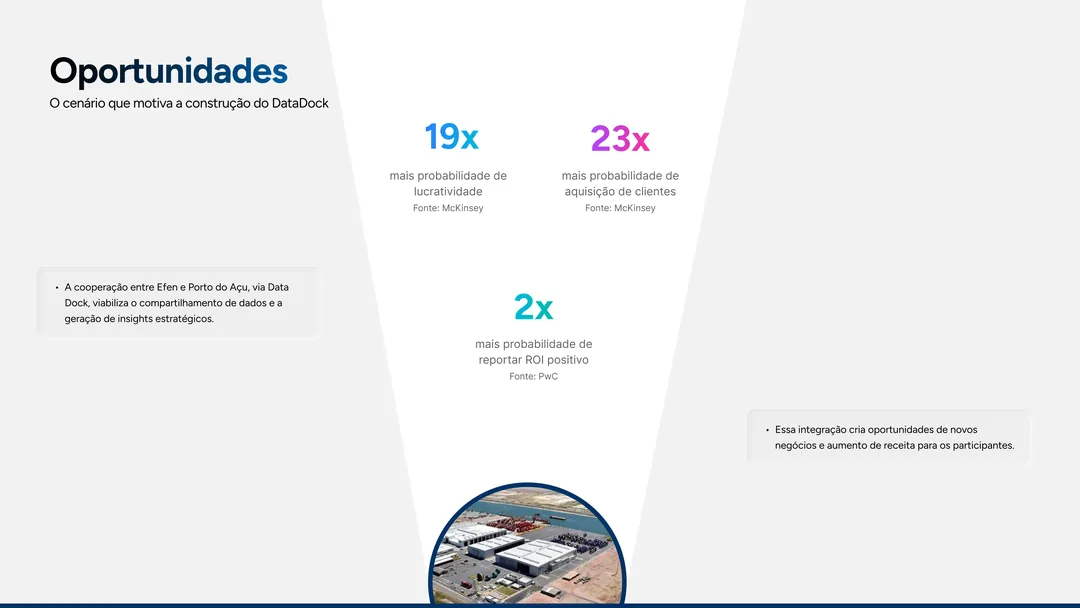
Datadock was launched as a market intelligence platform anchored in collaborative data sharing.
At the system's core sits a centralized Data Lake integrating operational logs from Port of Açu, EFEN bunkering records, and external maritime tracking sources.
Raw telemetry undergoes automated cleansing, semantic enrichment, and correlation modeling, unlocking strategic cross-analyses that were historically impossible using siloed sources.
The platform answers high-stakes questions for diverse ecosystem entities.
For Port of Açu, it pinpoints avenues to expand market share, reveals carrier traffic patterns, forecasts service demands, and identifies incoming vessels that could utilize port facilities.
For EFEN, it provides predictive foresight into upcoming bunkering demands, highlights qualified prospects, and exposes previously hidden commercial leads.
Far more than charting metrics, Datadock translates vast datasets into proactive commercial action.
Technical Architecture
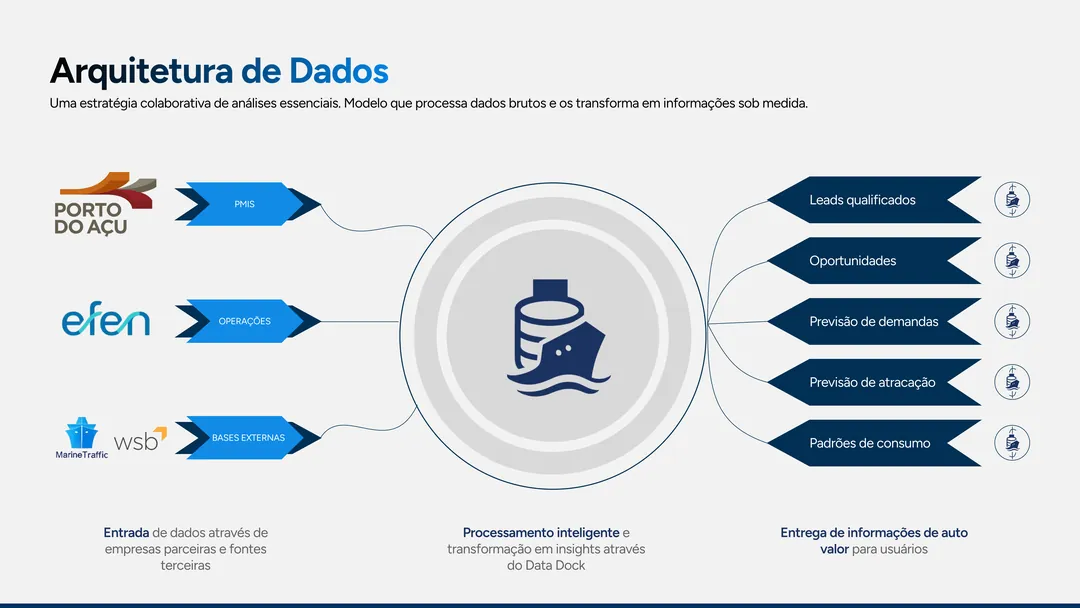
The infrastructure follows a modern, event-ready architecture centered on data pipelines and analytical processing.
Ingestion pipelines draw operational telemetry from internal port management systems (PMIS), EFEN logistics databases, MarineTraffic AIS feeds, and WSB intelligence.
Ingested records populate a centralized Data Lake where automated transformations perform deduplication, schema normalization, entity mapping, and metadata enrichment.
Analytical models query this consolidated foundation to surface behavioral patterns, operational correlations, and market opportunities.
Outputs are served through interactive dashboards and bespoke querying interfaces, enabling leadership to test hypotheses, track KPIs, and seize market opportunities.
In parallel with analytics, the platform integrates scoring algorithms that evaluate the freshness, accuracy, and utility of contributed datasets.
Every dataset is evaluated against rigorous governance metrics and scored based on its active contribution to insight generation.
This algorithm directly powers the platform's multi-tenant data monetization framework.
User Experience (UX)
While the engine processes high-dimensional, complex data streams, the interface was purposefully built for frictionless executive decision-making.
Rather than sorting through endless database rows, stakeholders get direct answers to concrete business questions.
The UX cleanly organizes key metrics, interactive maritime maps, smart filters, automated AI insights, and predictive analyses, empowering executives to explore market conditions without needing data engineering skills.
Every screen was designed to shrink the latency between asking a commercial question and obtaining a dependable, data-backed answer.
What Truly Changed
Datadock validated a breakthrough paradigm extending far beyond software engineering.
The initiative proved that collaboratively shared and normalized data yields infinitely more strategic value than isolated information retained in corporate silos.
The platform now answers commercial inquiries that previously required weeks of manual research—or were simply unanswerable due to disconnected repositories.
Alongside unlocking direct business leads for Port of Açu and EFEN, the platform laid the foundations for a collaborative, data-driven business model.
By pairing a clear governance model with value-based monetization, the project demonstrated that data sharing can transition from an operational cost into a net-new revenue generator for the whole maritime hub.
More than a technical proof of concept, Datadock validated a sustainable mechanism for converting operational telemetry into recurring commercial value.
Key Learnings
The paramount lesson from this initiative was that raw data does not inherently grant a competitive edge.
Substantive value emerges only when disparate operational contexts are systematically connected.
A second vital takeaway was that successful data ventures begin with governance long before software development begins.
Without transparent rules governing ownership, quality standards, and access permissions, analytical engines cannot produce trusted intelligence.
Furthermore, commercializing data requires verified trust among stakeholders. We met this requirement by designing compensation models that reward not just data volume, but primarily the tangible relevance of data to generating actionable insights.
Finally, the engagement proved that intelligent data architectures can spark entirely novel business models. Datadock evolved from an analytical dashboard into definitive proof that collaboration, governance, and intelligence can turn daily port operations into concrete growth opportunities across an entire industrial corridor.
Our Strategic Edge
Beyond delivering the technical solution, AutoU served as PRUMO's core strategic advisor in architecting Datadock's operational business model.
Our multidisciplinary team co-designed the data governance framework, quality benchmarks, usage metrics, and the monetization framework that proved the platform's commercial viability.
Rather than merely building digital tools, we helped establish the strategic foundations empowering Datadock to advance from a pilot project into a scalable ecosystem asset, uniting new partners and establishing a data-driven maritime economy.