
A platform that turned 500 scattered projects into a replication engine, using AI to identify cross-plant opportunities and convert operational learnings into financial savings.
The Challenge
Saint-Gobain Construction Solutions Brazil operates numerous industrial manufacturing facilities, seven distinctive brands, and an extensive portfolio of operational projects delivering verified cost savings. The challenge was never a shortage of positive results—it was a lack of institutional memory.
Every completed initiative produced valuable learnings. Yet that knowledge remained trapped within the specific factory where it originated. Cross-plant replication analysis depended on isolated spreadsheets and manual reviews, making comprehensive evaluation across high project volumes impossible. The organization was leaving money on the table not for lack of ideas, but for lack of a mechanism connecting proven solutions with plants where they had yet to be introduced.
The Context
With manufacturing plants distributed across Brazil, manually benchmarking operations was unfeasible. Each facility operates with different production outputs, product lines, and machinery configurations. Determining which projects from one plant could deliver measurable savings in another required analyzing hundreds of parameters for every individual initiative.
Existing workflows could not keep pace with project portfolio growth. Analytical backlogs expanded, high-potential projects remained trapped in operational silos, and missed savings opportunities went unnoticed simply because no one had the tools to calculate the unseen potential.
The Idea
If the root cause was high project volume and lack of data correlation, the remedy was not assigning more analysts to spreadsheets—it was engineering an intelligent model to execute cross-referencing automatically. The premise was direct: factories sharing comparable operational profiles have a high likelihood of replicating the same efficiency gains. Detecting these operational similarities and matching the right projects with the right plants was a job suited for machine learning algorithms, not manual reviews.
Our core hypothesis held that significant cost savings could be captured by systematically replicating just a targeted fraction of initiatives, provided the right projects were matched with the right industrial facilities.
The Real Barriers
Constructing an industrial project recommendation engine involves a complexity unseen in consumer recommendation systems: operational data is largely unstructured, logged idiosyncratically across plants without standard naming conventions, categories, or contextual tags.
Before training any algorithm, the data foundation had to be structured. Project records compiled under differing methodologies had to be consolidated, standardized, and enriched with machine telemetry from each facility. Without this foundational work, the model would produce misleading comparisons.
The second hurdle was scale: with hundreds of historical projects and dozens of manufacturing plants, manual similarity scoring was impractical. The system needed to uncover hidden operational patterns automatically and keep recommendations dynamically updated as new initiatives were logged.
The Solution: Replica AI
The platform operates through three tightly interconnected architectural layers.
The first is intelligent data structuring. Projects and facilities are harmonized within a single environment, standardizing telemetry on output capacity, machinery, manufacturing lines, and product families. Unsupervised machine learning models group plants by operational profile, generating similarity clusters that evolve dynamically as new facilities and initiatives are onboarded.
The second is similarity analysis and recommendation modeling. The algorithm benchmarks facilities within similarity clusters to detect projects that delivered proven ROI in one unit and exhibit strong operational compatibility with another. Recommendations arrive enriched with context: estimated savings, source plant benchmarks, and actionable guidance for local implementation.
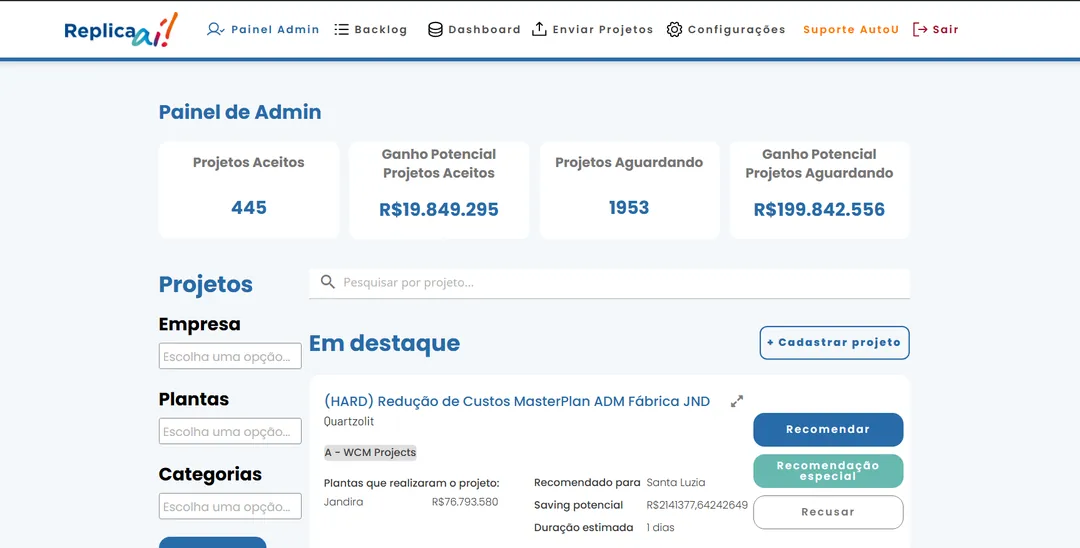
The third is the executive governance dashboard. Leadership monitors replication pipelines, accepted vs. pending projects, verified savings, and unrealized financial potential in real time without needing to compile manual slide decks. What was once fragmented over email threads is now a live command center displaying pending decisions and synchronized ROI metrics.
Platform Workflow
What Truly Changed
The metrics tell an undeniable story: more than 400 projects replicated, over R$ 8 million in verified savings realized since 2023, and an additional pipeline of R$ 16.4 million in identified potential. The platform eliminated 100% of spreadsheets previously used for manual analysis, returning 860 hours annually to engineering teams that were previously consumed by manual data compilation.
The most transformative impact, however, lies beyond recovered hours. It lies in giving enterprise leadership clear visibility into blind spots. Before Replica AI, answering "which projects from Curitiba could work in Recife?" took weeks of guesswork. Today, it takes seconds.
Key Learnings
Unstructured data is an invisible tax. Cleansing and standardizing project databases was not initially scoped as the top priority, yet it determined whether machine learning delivered high-value intelligence or pure noise. In enterprise environments spanning multiple facilities and brands, standardizing data logging is an absolute prerequisite for production success.
Recommendations without context fail to drive action. Early prototypes surfaced lists of suggested projects without grounding them in local plant realities, leaving teams uncertain how to proceed. Adding similarity context, financial benchmarks, and practical implementation guidance turned abstract lists into concrete operational decisions.
Project governance requires centralized visibility. Tracking dashboards were initially treated as secondary features. In practice, centralized metrics empowered managers to oversee execution without relying on manual reporting. Transparency is what transforms replication from sporadic good fortune into a systematic discipline.
Case AutoU × Saint-Gobain — Replica AI: Intelligent Project Replication Platform