
How Nestlé Built Loyalty with Thousands of Culinary Entrepreneurs Using AI, Gamification, and Market Intelligence
The Challenge
For years, Nestlé grappled with an operational paradox: small-scale culinary entrepreneurs were simultaneously their highest-volume repeat buyers and their least loyal customer segment. Professional cooks, cloud kitchen operators, bakers, and catering entrepreneurs purchase wholesale ingredients every week, but buy almost exclusively on price, switching brands freely.
Nestlé already maintained rich recipe portals, culinary educational content, and professional relationship channels. The breakdown was that entrepreneurs would read recipes on Nestlé portals, then purchase whatever brand was cheapest at local cash-and-carry markets. The brand was top-of-mind during preparation, yet absent at the point of sale.
The challenge was clear: how could Nestlé build a genuine brand relationship that connected directly to the physical purchase? The intuitive answer—requesting proof of purchase receipts—had historically been impossible to scale.
User Context
These users run fast-paced culinary businesses: meal prep owners, artisanal confectioners, neighborhood caterers. In most cases, they operate solo or manage small teams under intense daily pressure. While digital fluency varies greatly, smartphones serve as the operational nerve center of their enterprise.
This demographic required an experience that fit seamlessly into their hectic routine—not a generic points program, but a system recognizing what they were already doing without adding administrative friction. The user journey had to be simple enough for someone with zero time to spare, yet rewarding enough to influence repeat purchasing behavior.
The Idea
The core concept was straightforward: automatically identify Nestlé SKUs within receipts uploaded by entrepreneurs and reward purchases in real time without manual validation. The challenge lay entirely in technical execution.
Receipt-based loyalty concepts have existed for decades, but scaling across Brazil's decentralized wholesale landscape was historically impossible. With millions of transactions occurring across regional distributors and independent markets, receipts follow wildly divergent formats, printing styles, and abbreviated product descriptions with zero national standard.
Manual human review was economically unviable. Traditional OCR failed on messy receipts. What transformed the equation was the emergence of advanced multimodal computer vision capable of deciphering localized text patterns and matching Nestlé SKUs with exceptional accuracy. It was a long-standing business problem that finally met the right technological capability.
Barriers and Complexities
The foremost technical hurdle lay in extreme data variance. Invoices issued by local markets throughout Brazil follow no unified schema. The identical product appears under vastly different abbreviated descriptions depending on regional point-of-sale systems or cashier habits. A computer vision model trained on homogenous sample receipts would immediately fail in the field.
The second complexity was fraud mitigation. A rewards program offering monetary value based on uploaded receipts immediately attracts spoofing and duplicate submissions. The platform had to verify document authenticity in real time without introducing friction for legitimate buyers.
The third challenge was user retention. Launching an app was merely the beginning; motivating busy culinary entrepreneurs to return, upload new receipts, monitor rewards progress, and feel genuine value required a compelling experience layer beyond utility.
The Solution
The platform operates through three synchronized layers.
The first is computer vision recognition: entrepreneurs photograph or upload receipts. The AI parses the document, matches eligible Nestlé items, and calculates loyalty points in real time.
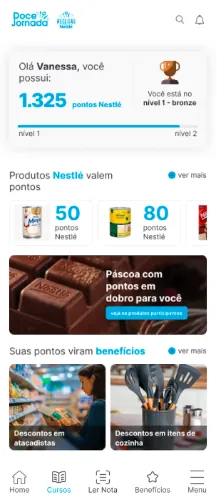
The second is rewards fulfillment: every currency unit spent on Nestlé products yields reward points redeemable for wholesale discounts, culinary merchandise, exclusive masterclasses, and leaderboard standing.
The third is gamification: badges, achievements, periodic missions, competitive rankings, and a virtual garage where users customize vehicles unlocked through their ongoing journey. These mechanics turn a standard loyalty scheme into an engaging progression experience with continuous positive reinforcement.
The application is live natively on iOS and Android for all registered program members.
Platform Workflow
Technical Architecture
The AI model was trained on a proprietary corpus spanning over 30,000 Nestlé SKUs, accounting for regional abbreviations, localized barcode variations, and irregular thermal print patterns from across Brazil. Thousands of synthetic simulations were conducted to stress-test edge cases, driving recognition accuracy above 98%.
To eliminate fraudulent submissions, the backend connects directly to fiscal tax authority APIs, validating digital receipt signatures in real time before releasing reward balances.
User Experience
The interface was crafted for users with limited digital patience, functioning smoothly in real-world kitchen environments where entrepreneurs handle phones between food prep tasks. The core flow executes in under two minutes: open app, photograph receipt, receive points.
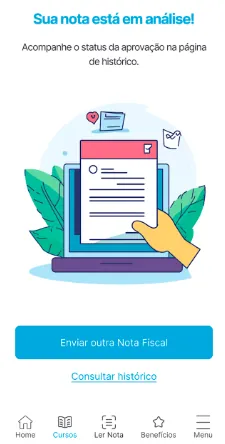
The application provides instant haptic and visual feedback during scanning, prompts clear corrective guidance if a receipt image is blurred, and displays transparent ledger history for accumulated points. The intuitive learning curve contributed directly to high user retention.
Results
Within months of a regional pilot, the platform demonstrated strong organic traction.
Beyond customer loyalty metrics, the solution unlocked an unexpected strategic asset: a real-time proprietary database capturing purchasing habits of micro-culinary businesses. Regional market share, category velocity, and competing brand baskets—insights Nestlé previously had to purchase from third-party research firms—are now generated dynamically by the platform itself.
Over 5,000 receipts verified and rewarded
More than US$ 100,000 in validated purchase volume
46% Nestlé market share across monitored product categories
Thousands of entrepreneurs actively engaged on the platform
The program's success earned widespread coverage across Latin American industry publications, and geographical expansion is currently underway.
Learnings
A primary takeaway was that the most transformative value delivered was not what was initially promised. The original brief was creating a loyalty app; what we ultimately delivered to Nestlé was continuous, high-fidelity market intelligence that bypassed costly research intermediaries. The secondary byproduct became the solution's most valuable corporate asset.
Another crucial insight centered on training data diversity. Achieving 98% recognition precision was possible only because training corpora reflected real-world thermal receipt variations across Brazil. Standardizing on clean datasets yields fragile models. Document AI must be trained on the messy realities of production environments.
Gamification is not superficial decoration. Without progression tiers, social recognition, and non-monetary rewards, engagement would have faded. Users do not return out of routine—they return because they have meaningful achievements to unlock.