
Zero Risk, Zero Queue: How AI Transformed Vehicle Lien Processing
The Challenge
Purchasing a vehicle requires verified documentation: verifying legal names, credit records, and official certifications to prevent fraud. Any subsequent transfer or lien modification on the same vehicle undergoes similar verification steps.
The immense volume of daily document validations made it nearly impossible to meet regulatory deadlines using 100% manual review. The operation had to modernize to remain viable.
The Context
B3 is the premier financial market infrastructure entity governing vehicular lien registrations in Brazil. Each chassis may be subject to missing documentation, title discrepancies, or legal encumbrances. When a vehicle owner executes a title transfer, they must submit comprehensive supporting documentation matching the specific legal reason for the procedure.
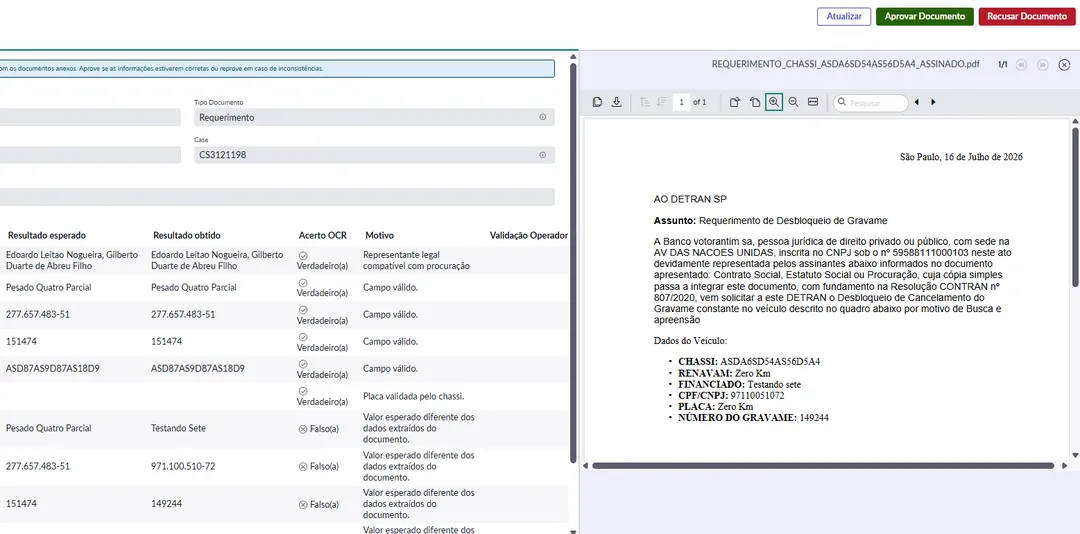
There are 9 distinct transfer legal reasons, each requiring a tailored set of supporting documents that must be reviewed and authenticated. This constituted an extraordinarily labor-intensive process, even for basic checks (tax IDs, names, signatures).
The Idea
B3 had already achieved great success with intelligent email triage. The document verification application followed a parallel logic: identify the legal transaction type, verify required documentation, extract field data, and cross-reference against trusted registries.
Furthermore, the backend workflows triggered following document validation were already proven. Only three rare legal transaction reasons were not yet automated, forming a parallel second development stream.
The Real Barriers
A large portion of submitted documents consisted of scanned physical paperwork (often historical registries or handwritten forms), necessitating robust computer vision (OCR) to extract text reliably. Correctly classifying document types required understanding the textual contents of each file.
The platform had to be elastic enough to handle peak submission waves with sub-second turnaround, while remaining cost-effective for long-term production sustainability.
Finally, document pipelines could not halt whenever an individual file failed validation: the processing queue had to advance continuously.
The Solution: AI Lien Release
An intelligent, highly scalable distributed architecture capable of ingesting multiple documents in parallel, classifying them across nine operational types, and triggering the corresponding validation workflows within B3's core systems.
Parallel processing: Ingestion and OCR extraction execute in parallel across worker pools rather than sequentially, preventing heavy multi-page files from blocking simpler transactions.
Document pre-processing: Scanned files often suffer from digital capture artifacts. To maximize extraction precision, files undergo automated pre-processing to boost contrast and resolution before OCR parsing.
Domain-specialized pre-trained models: Some documents carry handwritten notes or signatures. To ensure dependable parsing, we deployed specialized models fine-tuned on historical handwriting samples from public registry forms.
The Real Change
Deploying the intelligent document engine achieved full automated coverage across all mapped transaction reasons.
Centralizing submitted proof documents established a unified compliance repository, streamlining operator review and drastically reducing redundant document resubmissions.
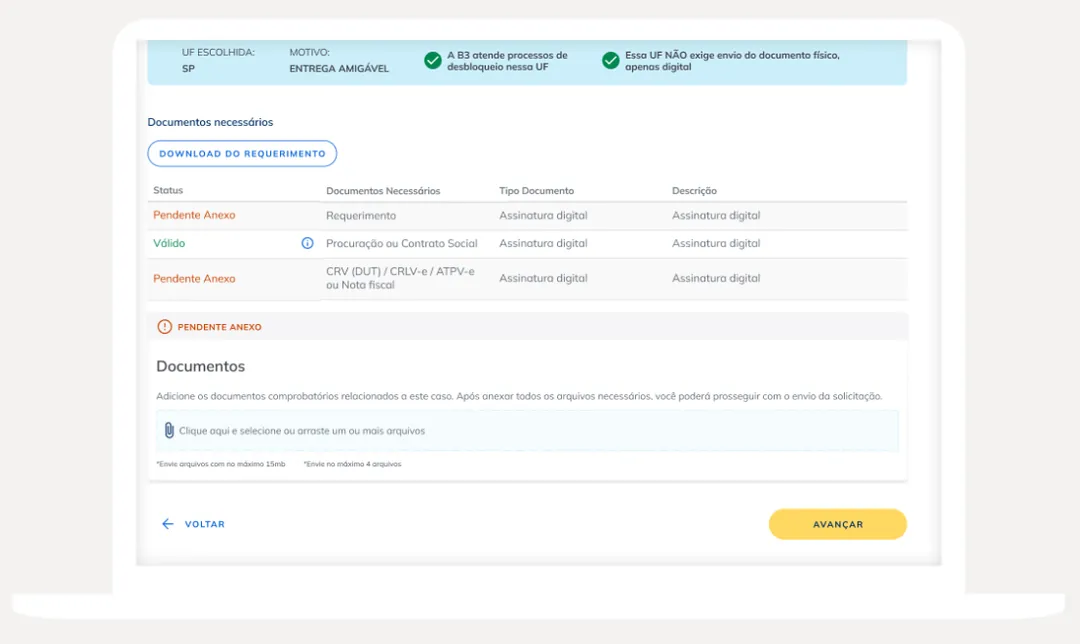
Operators were freed to dedicate their time to analyzing complex edge cases, supported by a 93% automated coverage rate across standard document triage.
Learnings
Intervening at the source of a workflow yields compounding returns. Intelligent intake classification immediately improved the quality of the existing document repository, unlocking fresh analytical capabilities across the archive.
Do not reinvent the wheel. Integrating with B3's pre-existing downstream workflows shortened delivery timelines, allowing engineering focus to center on OCR precision and classification calibration.
Human-AI collaboration. This implementation demonstrates AI augmenting rather than replacing human talent. Human operators remain essential for verifying complex legal exceptions, while AI eliminates repetitive clerical data entry.
Case AutoU + B3 — AI Lien Release