
How May I Help You: The New Era of Customer Support
The Challenge

Customer support remains heavily dependent on human operators. Every service inquiry carries subtleties, exceptions, and unique context that standard operating manuals rarely cover completely. At B3, the operational reality was no different.
An initial self-service screening menu was already in place, but its options were limited and rigid. Tickets were routed generically to departments without consideration of urgency. Handled exclusively by human specialists during standard business hours, this created operational bottlenecks that severely hindered turnaround times.
The Context
Customers contacting support often do not know which technical process to request to resolve their issue. They only know they have an urgent problem and expect immediate resolution. When available menu choices are vague or missing, customers instinctively bypass automated options to demand human assistance.
Peak hours generated volumes far exceeding operator capacity, resulting in long waiting queues—even though the vast majority of inquiries were standard, first-tier cases that could easily be resolved without human intervention.
The Idea
The hypothesis was straightforward: if our conversational agent could genuinely read and understand the user's initial inquiry, engage using clear and accessible language, and respond tailored to specific context, ticket triage would become far more effective and actionable.
Comprehensive reference documentation was already available to human operators. What was missing was feeding that knowledge into an intelligent agent equipped to provide flexible, evidence-backed answers in real time.
The Real Barriers
Building an enterprise conversational agent posed formidable challenges, even with rich documentation already available.
B3 had authored an extensive knowledge base to guide operators across hundreds of financial procedures. Over time, however, as processes were restructured and merged, manuals did not always keep pace, occasionally resulting in conflicting or outdated guidelines.
Response latency was another critical factor for delivering a viable user experience. Yet speed and precision often pull in opposite directions: spending more time curating inputs directly increases wait times.
Finally, to deliver real business impact, the agent had to perform concrete operational actions: opening formal support tickets, retrieving active protocol statuses, and escalating to human operators whenever context was insufficient or demanded specialized intervention.
A flawless user experience remained the paramount objective throughout.
The Solution: UIF Chatbot
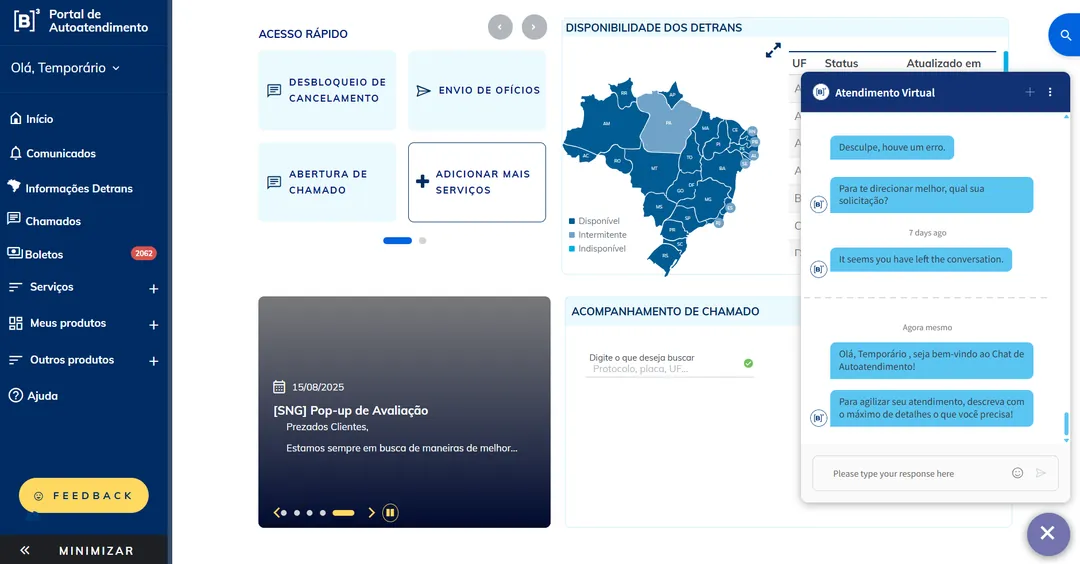
The UIF conversational assistant is an intelligent self-service agent handling diverse user requests. Available 24/7—even across public areas of the portal (with appropriate security restrictions)—it ensures continuous user support outside standard business hours.

Semantic vector search in seconds: Operators and supervisors author, refine, and maintain bite-sized knowledge units for every procedure directly within B3's secure environment. Each unit is vectorized into an embedding index. Incoming user messages are vectorized using the same algorithm and mathematically matched against the index, returning precise answers in seconds.
Personalized customer service: An advanced AI engine tailors responses to each interaction, conveying the attentiveness customers seek when speaking with a human agent. The assistant queries active protocols, external APIs, and internal knowledge to personalize every conversation.
Abstention philosophy: The rule engine employs chained models with segregated responsibilities. Before any answer reaches the user, it is audited and formatted, enforcing strict abstention whenever uncertainty exceeds thresholds and escalating to human operators only when genuinely necessary.
Far beyond casual dialogue, the solution integrates natively with live enterprise workflows in ServiceNow. Incident tickets are dispatched directly to designated teams, active protocol numbers provide immediate context, and access is securely gated through the official portal. These automated handoffs drastically reduce repetitive clerical tasks for human operators.
What Truly Changed
The most immediate operational breakthrough was realizing the vital importance of continuous content curation in operational manuals.
When mapping recurring support cases into structured flowcharts, analysts uncovered that only two out of every ten knowledge units contained fully up-to-date and actionable information.
First-tier resolution rates surged without any dip in customer satisfaction (NPS). Customers actively embraced the conversational interface, confident in receiving prompt assistance without queue bottlenecks.
Key Learnings
Data quality is the cornerstone of artificial intelligence. An extensive knowledge base provides little value without systematic maintenance. Intelligent agents require accurate references to determine subsequent actions, and enterprise guidelines evolve constantly over time.
Contextual visibility drives superior customer experiences. Adapting responses to user intent through available data ensured customers felt heard and understood. Retention and satisfaction rise dramatically when static menus are replaced with natural conversation.
Build agents, not mere chatbots. Real-time actions are what distinguish an exceptional enterprise tool from ordinary software. Resolving customer demands requires more than dialogue—it demands executing transactions, logging records, and integrating directly with core systems.
Case AutoU + B3 — UIF Chatbot: Intelligent Self-Service Assistant